Tag: bullying prevention

  • Preventing Bullying Through Science, Policy, and Practice

    Publication

    Released: May 10, 2016

    Bullying has long been tolerated as a rite of passage among children and adolescents. There is an implication that individuals who are bullied must have “asked for” this type of treatment, or deserved it. Sometimes, even the child who is bullied begins to internalize this idea. For many years, there has been a general acceptance and collective shrug when it comes to a child or adolescent with greater social capital or power pushing around a child perceived as subordinate. But bullying is not developmentally appropriate; it should not be considered a normal part of the typical social grouping that occurs throughout a child’s life.

    Although bullying behavior endures through generations, the milieu is changing. Historically, bullying has occurred at school, the physical setting in which most of childhood is centered and the primary source for peer group formation. In recent years, however, the physical setting is not the only place bullying is occurring. Technology allows for an entirely new type of digital electronic aggression, cyberbullying, which takes place through chat rooms, instant messaging, social media, and other forms of digital electronic communication.

    Composition of peer groups, shifting demographics, changing societal norms, and modern technology are contextual factors that must be considered to understand and effectively react to bullying in the United States. Youth are embedded in multiple contexts and each of these contexts interacts with individual characteristics of youth in ways that either exacerbate or attenuate the association between these individual characteristics and bullying perpetration or victimization. Recognizing that bullying behavior is a major public health problem that demands the concerted and coordinated time and attention of parents, educators and school administrators, health care providers, policy makers, families, and others concerned with the care of children, this report evaluates the state of the science on biological and psychosocial consequences of peer victimization and the risk and protective factors that either increase or decrease peer victimization behavior and consequences.
    Learn more about the report: nas.edu/ScienceOnBullying

    For more information, or to purchase this ebook: http://www.nationalacademies.org/hmd/Reports/2016/Preventing-Bullying-Through-Science-Policy-and-Practice.aspx

    #MattMasielloMD

  • Book Release- “A Public Health Approach to Bullying Prevention”

    The American Public Health Association is scheduled to release, “A Public Health Approach to Bullying Prevention”, co-edited by myself, Matt Masiello, MD, MPH, and Diana Schroeder, MSN, RN. This book highlights our evidence-based approach to bullying prevention and was written with educators, pediatricians, legislators, and community members in mind.

    Given the increasing burden of bullying in our United States schools, we assembled a team of 16 co-authors who are experts in the areas of bullying prevention and school-based health promotion. Together, we have created a comprehensive book that includes information about the consequences of school-based bullying from the perspectives of physical, mental, and public health, how best to implement, evaluate, and sustain an evidence-based bullying prevention program, school legislation, school climate, the cost benefit of bullying prevention, capacity building, and practical implications for school administrators.

    To read the full article about the release of “A Public Health Approach to Bullying Prevention”, please visit, http://thenationshealth.aphapublications.org/content/43/5/5.1.full


  • Summary of Recent Publication- The Implementation of a Statewide Bullying Prevention Program: Preliminary Findings from the Field and the Importance of Coalitions

    Schroeder, B. A., Messina, A., Schroeder, D., Good, K., Barto, S., Saylor, J., & Masiello, M. (2012). The implementation of a statewide bullying prevention program: preliminary findings from the field and the importance of coalitions Health Promot Pract (Vol. 13, pp. 489-495). United States.

    ———–

    Recognizing bullying and low-level violence as a serious public health concern, The Center for Health Promotion and Disease Prevention at the Windber Research Institute has effectively shown to reduce bullying in schools through the Olweus Bullying Prevention Program (OBPP). Bullying is defined as a person being repeatedly exposed to negative actions by one or more person while lacking the ability to defend themselves (Olweus, 1993). Studies show in American schools, bullying affects nearly 30% of all students, daily, causing feelings of decreased safety, low personal satisfaction and self-esteem, and anxiety. Victims may experience low academic achievement, a greater chance of dropout, and absenteeism in schools. In taking a systematic, evidence-based approach, OBPP has been applied to populations worldwide, being labeled as the most effective bullying prevention programs in the world and is endorsed by the American Academy of Pediatrics (AAP). OBPP utilizes four components of concentration in the program: school, classroom, individual, and community initiatives.

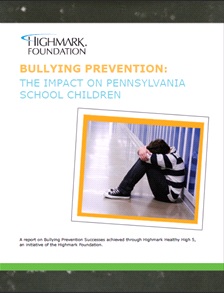
    In 2000, the Highmark Foundation developed the Highmark Health High 5 initiative and started to provide more than six million dollars of funding to two bullying prevention programs.  Both HALT! A Bullying Prevention Program, led by the Windber Research Institute, and PA CARES (Creating an Atmosphere of Respect and Environment for Success), led by the Pennsylvania Department of Education, coordinated their programs along the guidelines of the OBPP.  HALT! and PA CARES determined an overall goal to provide and monitor bullying prevention strategies to schools across western and central Pennsylvania. This effort was informed by the PRECEDE-PROCEDE framework.

    With HALT! (WRI) managing district-wide implementation and PA CARES (Department of Education) monitoring building-only implementation, the Olweus Bullying Questionnaire (OBQ) was provided for students to evaluate student bullying behavior, perceptions, and teacher’s responsiveness.  Surveys were collected from HALT! cohorts after two years of program implementation providing positive results.  High school bullying reductions were reported in bullying between 15% and 39%.  Teachers spoke to students regularly about bullying, marking increases of anywhere between 14% and 131%.  Overall, the communication of bullying perceptions and school rules regarding bullying had increased in students, ranging from 17% to 69%.  Additionally, the program increased parental involvement in student bullying between 14% and 81%.  In elementary schools, more students testified to be willing to aid bully victims.  The data collected seemed to support the overall OBPP observation that bullying prevention efforts are more effective on a long-term basis.

    On a large scale, the Olweus Bullying Prevention Program and charitable foundations have taken a leadership role, making public health of children a priority.  Collaborating on bullying prevention efforts has resulted in school success on a long-term basis.  By providing partnerships compared with the public health model, students may experience benefits in school climate, the community, and their lives.


    References

    Olweus, Dan. (1993). Bullying at school : what we know and what we can do. Oxford, UK ; Cambridge, USA: Blackwell.


  • Summary of Recent Publication- The Role of a Health Care Foundation in a Statewide Bullying Prevention Initiative

    Schroeder, B. A., Messina, A., Holliday, C., Barto, S., Schroeder, D., & Masiello, M. (2012). The Role of a Health Care Foundation in a Statewide Bullying Prevention Initiative. Academy of Health Care Management Journal, 8(1), 33-40.

    In the field of health promotion, bullying in schools has been considered a priority and focal point of research throughout the past few years. Bullying is recognized as an individual with little defenses repeatedly experiencing negative actions from one or more persons.  Studies prove that bullying victims experience a greater change of serious health concerns such as depression, low self-esteem, and suicidal thoughts over their lifetime. However with the unrivaled support from a health care foundation, a bullying prevention program has been implemented on a wide scale in Pennsylvanian (U.S.) schools. Over a three year period, bullying has been addressed among 15 percent of school children in Pennsylvania to become the largest health promotion initiative focused on school bullying in the United States.

    In the past 70 years, Highmark Inc. has benefited many school-aged children in the Pennsylvania area.  In 2000, Highmark launched the Highmark Healthy High 5 to address nutrition, physical activity, grieving, self-esteem, and bullying prevention in children and teenagers ages six to eighteen.  The $100 million health promotion effort provides multi-year grants to community partners focused on the initiative as well.  By providing a significant amount of grant money, two advanced bullying prevention programs have been able to develop and flourish based on the internationally accepted, systematic and holistic Olweus Bullying Prevention Program (OBPP).  Leading in the largest OBPP implementation in the United States, approximately 260,000 out of 1,775,029 students have been reached in Pennsylvania.

    With the provision six million dollar grant, bullying prevention initiatives known as HALT! A Bullying Prevention Program, coordinated by the Windber Research Institute (WRI),and PA CARES (Creating an Atmosphere of Respect and Environment for Success), coordinated by the Pennsylvania Department of Education,have used OBPP to concentrate on school-wide, classroom, individual, and community bullying prevention measures.  HALT! managed district-wide implementation, while PA CARES focused on the implementation of OBPP in specific school buildings in a three year study.

    By using the Olweus Bullying Questionnaire (OBQ) on students in grades 3-12, data was collected assessing bullying issues, attitudes and beliefs about bullying, bystander perceptions, and student’s satisfaction with school.  107 total schools and 56,137 students participated in the OBQ by the end of the second year of the study.  Overall, the OBQ remained positive after program implementation, reporting a decrease in self-reports of bullying.  On the high school level, the prevention efforts decreased bullying by 15 to 39 percent.  In elementary schools, 27 percent more students testified that they would do their best to aid a bullied student after two years of implementation.

    With a goal to produce positive changes in school environments regarding bullying, the Highmark Health High 5, HALT! and PA CARES have reduced bullying incidents in schools while nurturing  a climate of positive peer relations and adult involvement.  By using evidence-based public health programs, bullying has comprehensively been addressed as a major health issue.  In the largest OBPP implementation in Pennsylvania and the United States, Highmark also had led the first pilot of OBPP in high schools within the United States.  Through the Highmark Foundations public health initiatives, programs such as the Olweus Bullying Prevention Program can remain on the radar of individuals to provide positive changes in school climate and students’ lives while reducing long-term health care expenses.


  • The Cost Benefit of Bullying Prevention: A First Time Analysis of Savings

    The Center for Health Promotion and Disease Prevention at the Windber Research Institute and the Highmark Foundation recently published, “The Cost Benefit of Bullying Prevention: A First Time Analysis of Savings“. This report demonstrates the cost benefit of  school-based bullying prevention from three perspectives, the perspectives of health care organizations, schools, and society as a whole. Bullying is a pervasive behavior that may have a negative impact on children, sometimes, even into adulthood. Nonetheless, through the implementation of an evidence-based, bullying prevention program, we have demonstrated the ability to allay academic, social, and health adversities related to bullying. While reading “The Cost Benefit of Bullying Prevention: A First Time Analysis of Savings“, please keep in mind that the purpose of this report is to shed light on the benefit of implementing bullying prevention.