Category: Education

  • Health is Everywhere

    BY MATT MASIELLO, MD, MPH
    Often times the feeling is the opposite; it is illness that is everywhere, not health. With the U.S. population experiencing a continuing surge of chronic illness, costing this country, we Americans, 80% of the money we spend on health, why should we think that illness is not here to stay. Sadly, the U.S. is not leading the international charge in maintaining and sustaining maximum health for all citizens. The present generation of U.S. children could be the first to have a lower life expectancy than their parents’. Forty-six-plus million individuals in this country live without health insurance and that number will only grow as the economy suffers.

    Sick Around the World,” a Public Broadcasting Station (PBS) documentary, reviewed the stark comparisons between the health care systems of several countries to that of the U.S. The one interesting question asked of the health care leaders of the five countries was: “Would a citizen of your country ever go bankrupt over a hospital bill?” The response was “not possible” or “never,” along with a facial expression of surprise and wonder that the question was even asked. When the small country of Taiwan had the opportunity to re-invent their health care system in the 80s they identified the advice of those countries considered to have the best health systems. When asked, and again with a polite pause in the conversation, the Taiwan spokesperson responded that the U.S. was not one of those countries.

    These countries certainly have issues and obstacles in providing the very best health care. However, “health” is considered a human right and thus they are committed, through political will and leadership, in making it work.
    Ilona Kickbusch, a well-known health care author and academician, who has worked and lectured on both sides of the Atlantic, speaks of the roles of hospitals in the “health society of the 21st century.” At the 2007 World Health Organization-Health Promoting Hospital Network (WHO-HPH) meeting in Vienna, Austria, she eloquently and simply stated that “health is everywhere.” And in that environment she describes the important role of hospitals in identifying and utilizing “health.” Health care professionals from around the world gathered at the annual event to discuss how hospitals can identify themselves as public health advocates for their patients, hospital staff, community and environment. David Ollier of Hospitals and Health Networks wrote of the minimal participation by the U.S. in the international organization in his 2007 article, entitled “American Exceptionalism,” where he comments on “where one is a lonely number.” Nicely, so that “one” (hospital) is in Pennsylvania.
    The WHO defines health as “a state of complete physical, mental and social well-being and not merely the absence of disease and infirmity.” In the U.S. we do a good job in curing diseases and treat illnesses for some, not all. We are less proficient in the area of hospital based disease prevention, health promotion or public health or public health advocacy.

    So, what can U.S. hospitals and health care systems do to realize and benefit from the fact that health care can also be everywhere? First, there is the issue of leadership. We need a different type of health care leader. Hospital CEO’s, Presidents, Trustees should have training, experience, background and appreciation of the broad social and health issues of our day, as well as manage the day to day operations of the health care system. These new health care leaders must find that common ground of how hospitals can obtain the optimal profit margin as well as strategically serve as public health advocates for the communities they serve. Second, the international arena is the “health” classroom where we can learn. If we have the desire, fortitude and leadership to redesign our U.S. health care system our hospitals, managed care organizations and political leaders must make the effort to identify this new health care leadership as well as reach out internationally for this level of expertise. The WHO-HPH network would serve as a viable resource.

    According to Ilona Kickbush, hospitals must begin to live in the four domains of health – medical health, personal health, public health and the health market. In the health market alone, she describes 18 categories of potential activity. To participate and excel in these activities a new kind of political and health leadership must rise up and be able to speak beyond the important but limited topics of “access to care”, “health insurance for all”, or “reimbursement for clinical services.” For the U.S., we need to strategically create the balance between the attention and funding we provide for treatment of chronic illness and technology and the more encompassing “health society” of health promotion, wellness and disease prevention. As steam was an economic driver in the 1800s, steel in the 1850s, electricity in the early 1900s, the automobile in the 30s and information technology in 2000, health must become the driver in the decades to come. Kickbush and others have commented on these comparisons, with wellness, health promotion and medical technology as being the economic driver for 2050.

    And lastly, we must also be willing to retrain our health care professionals. Though we may need more nurses at the bedside of our hospitalized citizens we also need nurses, as well as physicians, who are trained to “clinically” promote the health of the patient beyond that of the hospital bed and back to their homes and work places. Europe, Asia and many other countries are forging ahead on these health care practices. We must work to change how we do health in America.
    It is time we counter the impression and opinions of others by reflecting upon a quote from Winston Churchill: “Americans are a wonderful people in that they always find the right answer…after they have tried every wrong answer first.” We can do better, we must do better, and we must find the right answer to better health.

    Dr. Matt Masiello, Director, The Center for Health Promotion and Disease Prevention, Windber Research Institute & Windber Medical Center, and Project Coordinator (U.S.-based), International HPH Network, World Health Organization-Collaborative Center (WHO-CC), Copenhagen Denmark, can be reached at m.masiello@wriwindber.org or (814) 619-6168

    4 December 2008 http://www.wpahospitalnews.com HospitalNews

  • Preventing Bullying Through Science, Policy, and Practice

    Publication

    Released: May 10, 2016

    Bullying has long been tolerated as a rite of passage among children and adolescents. There is an implication that individuals who are bullied must have “asked for” this type of treatment, or deserved it. Sometimes, even the child who is bullied begins to internalize this idea. For many years, there has been a general acceptance and collective shrug when it comes to a child or adolescent with greater social capital or power pushing around a child perceived as subordinate. But bullying is not developmentally appropriate; it should not be considered a normal part of the typical social grouping that occurs throughout a child’s life.

    Although bullying behavior endures through generations, the milieu is changing. Historically, bullying has occurred at school, the physical setting in which most of childhood is centered and the primary source for peer group formation. In recent years, however, the physical setting is not the only place bullying is occurring. Technology allows for an entirely new type of digital electronic aggression, cyberbullying, which takes place through chat rooms, instant messaging, social media, and other forms of digital electronic communication.

    Composition of peer groups, shifting demographics, changing societal norms, and modern technology are contextual factors that must be considered to understand and effectively react to bullying in the United States. Youth are embedded in multiple contexts and each of these contexts interacts with individual characteristics of youth in ways that either exacerbate or attenuate the association between these individual characteristics and bullying perpetration or victimization. Recognizing that bullying behavior is a major public health problem that demands the concerted and coordinated time and attention of parents, educators and school administrators, health care providers, policy makers, families, and others concerned with the care of children, this report evaluates the state of the science on biological and psychosocial consequences of peer victimization and the risk and protective factors that either increase or decrease peer victimization behavior and consequences.
    Learn more about the report: nas.edu/ScienceOnBullying

    For more information, or to purchase this ebook: http://www.nationalacademies.org/hmd/Reports/2016/Preventing-Bullying-Through-Science-Policy-and-Practice.aspx

    #MattMasielloMD

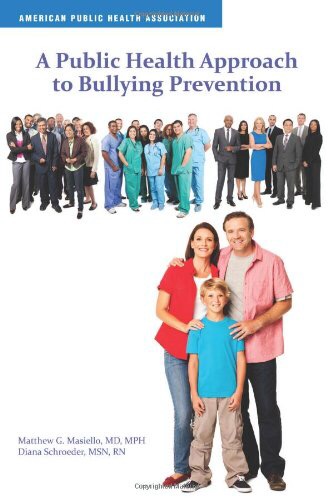
  • A Public Health Approach to Bullying Prevention

    A Public Health Approach to Bullying Prevention will serve as a practical, sustainable, cost-efficient strategy to tackle bullying. More importantly, it may be the best approach to providing legitimate and sustainable hope to our children at a time when bullying is becoming increasingly more difficult to tackle.

    This book presents a public health approach to bullying prevention in a comprehensive and deliberate manner. Formal public health strategies have been used to combat infectious disease epidemics, tobacco use, and motor vehicle injuries. When applied to bullying, public health strategies provide a scientific approach to community planning, the use of evidence-based programs, coalition development, and the ability to change the culture in a school and community to one that is positive and strong. This text will serve as invaluable resource to parents and professionals looking for advice on specific facets of school-based bullying.

    Available on Amazon: https://www.amazon.com/Public-Health-Approach-Bullying-Prevention/dp/0875530419

    A Public Health Approach to Bullying Prevention is a valuable resource on how to assess, apply, and evaluate public health interventions to reduce bullying and violence in schools. Anyone intending to launch a bullying prevention program should begin by reading this book. —Donald S. Burke, MD, Dean, Graduate School of Public Health, University of Pittsburgh


    #MattMasielloMD

  • Education in America / Education in our Communities

    In her book, The Death and Life of the Great American School System, Diane Ravitch presents an informative and historical review of how our national school system has changed and not for the better. Over the past twenty years she had the opportunity to work on both sides of the political fence, and, while in either respective camp; she initially felt that the policies were generally good. With input from other educators the policy makers at the state or federal levels were able to implement school based improvements into curriculum or introduce vouchers or approve charter school development. No Child left behind (NCLB) legislation was one such example. Ravitch and other independent educational researchers now conclude that in very large part these politically formulated initiatives failed.

    Thirty to fifty years ago, U.S. students were competing against other U.S. students. This is no longer the case. According to Bill Gates, by 2020, 123 million U.S. jobs will be high skilled and high paying with only 50 million American college students qualified to fill them. Clearly, American high school students are no longer in competition with only their American peers, but are now competing with their international counterparts. The University of Pittsburgh recently stated that they are determined to have their students compete internationally. However, this process cannot begin in our colleges and universities. Finland starts with early education, a universal health plan and all children having the right to an education. In addition, special education opportunities are available for all students not just those with mental health, intellectual or physical disabilities. Prior to the 1970s, American public schools were the best in the world, producing Nobel Prize winners, U.S. Presidents, and CEOs. Unfortunately, this is no longer the path we are on. Of 30 developed countries, the U.S. ranks 25th in math and 21st in science. Similarly, our top 5% of students rank 23/29 when compared to developed countries.

    The cost to educate a child in U.S. has doubled since 1970. Student reading and math performance scores, however, have been flat over this same period of time. Nonetheless, over the decades, the one saving grace has been the teacher. Educational experts tell us that with high performing teachers, students progress three times faster than their counterparts. With poor performing teachers the reverse occurs. As told in the powerful documentary, “Waiting for Superman,” it is estimated that if we can eliminate the lower 10% of our poorly performing teachers the average U.S. student could potentially reach the academic level of a Finn student. Finland presently has the best student academic performance rating in the world. Teachers in Finland receive the best education and have the freedom to teach without the burden of onerous standardized testing and ill-defined paperwork. These educators are well paid and evaluated frequently by their academically stellar mentors. In fact, the Finn teaching profession is held in higher regard then that of medicine, law or engineering.

    The studies have demonstrated that despite the failures we have experienced in trying to turn our schools around with No Child Left Behind (NCLB), cyber or charter schools, vouchers, etc., researchers have been able to define what does work. Quality teachers, more class time, academic accountability, and high curriculum standards are the mainstay of quality education in many countries with better student performance.

    As a nation we have not seen meaningful improvement in the academic performance of our students with the use of vouchers or the development of charter schools. There are exceptions, however. The New York charter school designed by Geoff Canada, an educator, or the KIPP (Knowledge is Power Program) schools, also developed by educators. With only a few exceptions, we have not benefited from voucher or charter schools. Though the concept for both or either was initially good and well-received the great majority were not advanced by educational leaders but by policy makers and for profit non-educators. Money was pulled from the community public school system budgets and a few market driven school managers, not educators, made some very nice incomes. Though some charter schools may have demonstrated a small, positive blip in student test scores, a great many saw a plateau or a decrease in scores. Vouchers were not used when available. Not all families with children failing academically in their failing schools can afford the time or money to transport their child across town to a carter school. Many charter schools either folded or became academies for the upper middle class or rich of the city or community. As sadly depicted in Waiting for Superman, it is not quite that Norman Rockwell American scene when an auditorium full of our economically challenged minority families are waiting for, and many losing out, in a local charter school lottery. In paraphrasing an educational consultant from Finland, “the poverty in America prevents me from conveying our successes in Finland to the American educational system.”

    The NCLB legislation only tests for the achievement of basic knowledge in math and reading and not in science, history, language and geography. NCLB is testing for proficiency, not excellence. The legislation has negatively affected the lives of millions of American children and for years to come. As teachers worked hard on preparing children for the NCLB tests they were taken away from teaching the other important courses. Today, the studies are showing how NCLB is not working in many of our schools and certainly will never raise us to international competiveness. This week it was announced that ten states have opted out of the NCLB mandates because we have not been able to reach high academic standards with NCLB. The same legislation was supported by both democrats and republicans. Sadly, a republican candidate for U.S. presidency now publically states and apologizes for voting for NCLB. “It was against my principles I believed in….sometimes you take one for the team.” At least he apologized. He, however, is now different from ill informed school board members, local politicians and local taxpayers who feel that they now can make a legitimate contribution to my children’s education and future livelihood.

    In those communities across America where lawyers, business leaders or policy makers were asked to come in as school superintendents, many of these communities eventually saw less than stellar results, significant money spent, parent anger and an exodus of good teachers. Teachers are not business people. They do not like to be bullied, as many were in California and New York, by a superintendent or chancellor who was not an educator or a school board and city politicians who put money and test results over curriculum. Across America, communities such as mine are being challenged with the fact that our schools are losing their prominence as the foundations to their neighborhoods. Somehow we accept the fact that the politician can create a law that could essentially close a school or at the very least give parents the strange opportunity of sending their children to another school. It is easier said than done for most parents struggling economically but not so for the politician who is receiving that weekly check and guaranteed health insurance. Whether it is due to the disgruntled taxpayer, that latest educational politician, the micromanaging school board or the school union educators are losing their hold on their schools. Some of this is deserves, most not. At the very least if we do not resurrect the credibility and leadership of the educator with the educators leading the way our national educational system will continue the international slide to mediocrity and failure.

    So, what is our obligation to our children? To the benefit or demise of our educational process to what degree do teacher unions, school boards, and taxpayers direct the educational process in our communities and in our country? Do we do the right thing to turn this educational process around or the money saving thing? Do we have the fortitude? Bill Gates offers the challenge that “The status quo can change. It will take a lot of outrage and a lot of good example”. But unlike big business you cannot turn things around in a year or two. How do we deliberately change and enhance the initial and ongoing education of our teachers? The educational motto in Finland where the students have the highest performance internationally and spend less money to do so, is “good teachers, good schools.”

    According to several nationally recognized educational experts, school boards need to make sure their school has the best superintendant, the best teachers, the best business manager and, most importantly, the best curriculum. They need to do their best to show the community of parents, teachers and taxpayers that they are doing their job, which is to educate our children to be the best in the world. School boards need to prevent politicians and the mob of educator wannabes from taking over the responsibility of educating our children and let their academic leadership do just that, lead. Teachers should be evaluated by excellent mentors and not by test scores. They need to continually research their field of education. A testing process developed by politicians does not work. Massachusetts apparently stands out here in the U.S. as doing it right. We may not have to go to Finland to learn all of what we need to know to get it right in America. Schools, parents, school boards, school districts, communities, counties and states must work with and support the educational leadership in order to fix, enhance and sustain community public schools.

    Foundations, hospitals, colleges, universities and businesses need to redefine their mission, charitable giving and grant processes. Do they fund the many popular but ill-defined specialty projects or do they fund education? Teacher research opportunities, teacher mentorship initiatives and teacher incentives to obtain the best education possible would be a great start in the redirection of individual and corporate wealth and foundation grant activity. With this in place, we can then test our students, but let the teachers do the testing, not you, me or the politicians. When Bill Gates was asked what would be the single thing to do to improve the American school system his reply was, “hire great teachers, more than money spent on anything else, more than technology……..”

    But unlike big business you cannot turn things around in a year or two. How do we deliberately change and enhance the initial and ongoing education of our teachers? The educational motto in Finland where the students have the highest performance internationally and spend less money to do so, is “good teachers, good schools.”

    According to Ravitch, “schools should be the anchor of our communities; and effective education requires enormous effort with collaboration and consensus at many levels.” History tells us that schools will not improve if elected official intrude into the territory of curriculum and make decisions that should be made by professional educators. Though some market driven, educational arm chair experts may consider principals to be middle management personal, historically; this has not been the case. The principal should be that “head teacher” evaluating teachers and helping them to teach well and prompt them on to be the best at what they do – teach. If that teacher or principle is not there yet, we can surely help them get to that point of excellence.

    Matt Masiello

    Dr. Masiello is a pediatrician and public health professional. Over the past twenty years he has worked extensively in school systems and communities as a pediatrician and health consultant. Dr. Masiello has also written and presented nationally on the rights of children.